Shopify Dropshipping in 2027: Is Shopify Collective Worth It?
Shopify Collective lets you sell other Shopify brands' products with no inventory. Who can join, how the money flows, the limits, and the margin Shopify cites.
- Written by
 Fahad, CEO & Head of Development
- Published
- Reading time
- 4 min
- Audit Standard
- Real CrUX Data
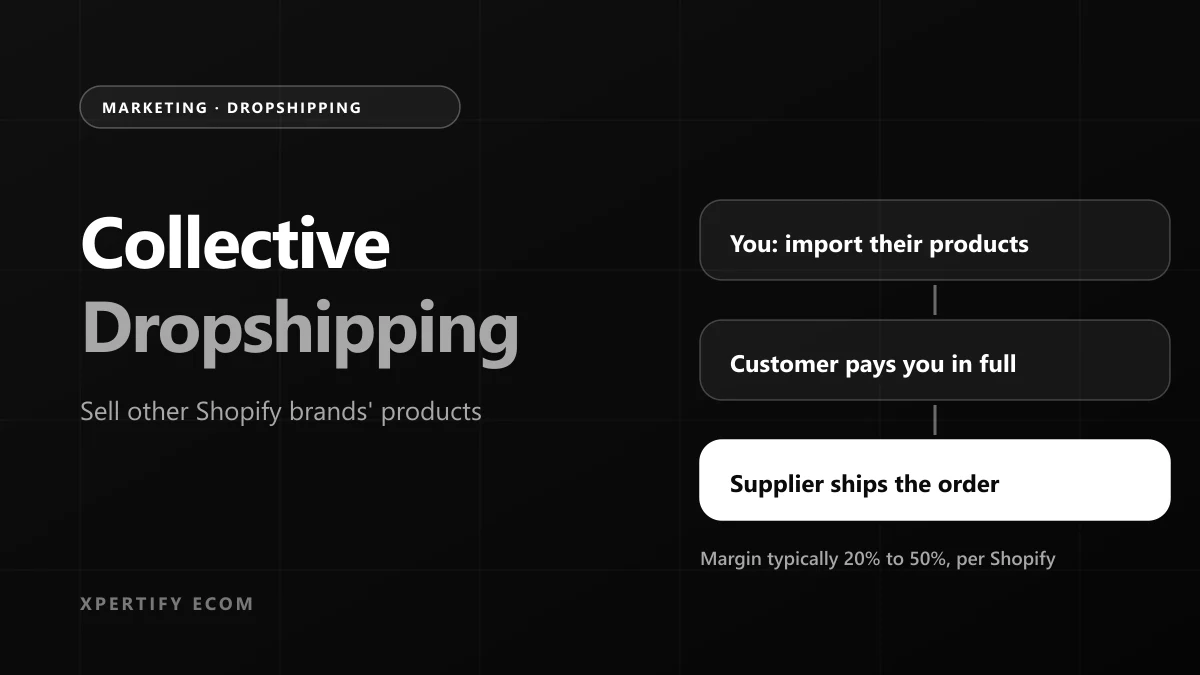
Shopify Collective is a network where Shopify stores sell each other's products. As a retailer you import a supplier's products into your store with no inventory cost, the customer pays you, and the supplier ships the order. It is free with eligible Shopify plans. It is not the same as sourcing from a marketplace and shipping from overseas, because suppliers are other Shopify merchants in your own country and currency.
This guide follows Shopify's Collective pages and Help Center, linked at the end and read in November 2026. Shopify's pages did not state a required shipping time, a customer-disclosure rule or a commission percentage, so we do not invent one. We do not say Collective is a good business on its own: it is a tool.
How it works
- 01You connect with a supplier by importing from a public price list, requesting pricing, or inviting a supplier you already know.
- 02You import their products, with no inventory cost or commitment.
- 03A customer buys from your store and pays you through Shopify Payments. You receive full payment.
- 04The order goes to the supplier, who fulfils and ships it to the customer. Tracking syncs back, so your branded shipping emails go out.
- 05The product cost plus shipping is paid to the supplier from your Shopify Payments balance.
Who can join as a retailer
- An active Shopify plan. The Pause and Build plan is not allowed.
- A store in a supported country and currency. Shopify lists 38 countries and 18 currencies, so check the list for yours. To connect with a supplier, both stores must share the same country and currency.
- Shopify Payments set up with active payouts, and the payout currency matching your store currency.
- UK and EU businesses must use Shopify Tax, Basic Tax or a third-party tax app, not Manual Tax.
- You accept Collective's terms and Shopify's Acceptable Use Policy, and pass trust, safety and fraud checks. ID verification may be required.
- Shopify Network Intelligence must be turned on in your privacy settings.
How you and the supplier get paid
With automatic payments, which are on by default for eligible stores and carry no extra charge, the product cost plus shipping is debited from your Shopify Payments balance when the order is placed. The funds are held and transferred to the supplier when the supplier marks the order fulfilled. If your balance is too low, Collective retries the debit, the order shows Payment pending, and some suppliers may delay shipping. PayPal and other non-Shopify Payments methods do not add to the balance, so Shopify suggests weekly or monthly payouts to keep a larger balance.
Margin and fees
Shopify says Collective is free for eligible stores, with no setup fees and no extra charge for automatic payments. It says margins vary by supplier but typically range from 20% to 50%. That is Shopify's general statement, not a promise, and it does not include your ads, apps or time. Your payment dashboard shows net product margin per supplier, which can take up to 24 hours to update.
What does not work
- No digital products or gift cards.
- Not compatible with Managed Markets, pickup in store or metafields.
- You can add Collective products to POS, but they ship only to the customer's address.
- Duties, taxes and tariffs on international labels are not passed from retailer to supplier.
- If your store or a supplier loses eligibility, you cannot sell the imported products until it returns.
Compatible with Collective products: product bundles, subscriptions, combined listings and Shopify Flow on the retailer side.
The service standards Shopify sets
Shopify's community guidelines, described as best practice rather than hard rules, ask retailers to respond to customer support within 48 hours, check customer lost-package reports before involving the supplier, and keep returns within the agreed window. Your return policy decides how returns and refunds work with the supplier. Read it before you promise customers anything.
Who it suits, and who it does not
| Collective fits | Look elsewhere |
|---|---|
| A new store that wants a catalogue without buying stock | A store that needs the lowest possible product cost |
| A brand adding complementary products to an existing audience | Sellers who want products from overseas factories shipped direct |
| Owners who want shorter shipping within their own country | Stores outside the supported countries |
Whatever you sell, you still need a store that loads fast and convinces a stranger. Read our launch guide before you list a product.
Want a store built to sell imported products properly, with fast pages, clear shipping and returns, and a checkout that converts?
See store development